
New to creating challenge coins? Learn the absolute basics all on ONE page.
Below you’ll learn all the basics of challenge coins: metals, coin finishes, sizes, cutouts and even sandblasting!
This is an easy-to-read blog with over 50 REAL coin examples! There’s a lot to cover, but it’s made into short sections for easy learning. Let’s start learning the essentials or jump to a blog section:
- New to creating challenge coins? Learn the absolute basics all on ONE page.
- Enamel colors
- Coin Metal and Finishes
- Coin sizes
- Round and Non-round coins
- Offset Printed coins
- Coins with Epoxy
- 2D vs. 3D coins
- Sequentially Numbered coins
- Edge Cuts
- Reed Edge
- Edge Text
- Sandblast Texture
- Coins with cutouts
- Getting a coin Proof
- What are dies / molds?
- Coin Thickness
- Coin Packaging Options
- How many coins should I order?
- Test Yourself!
- Congratulations!
Enamel colors
Adding enamel colors to your challenge coins is absolutely optional. Enamel colors can be added to one or both sides of your coin (photo below).
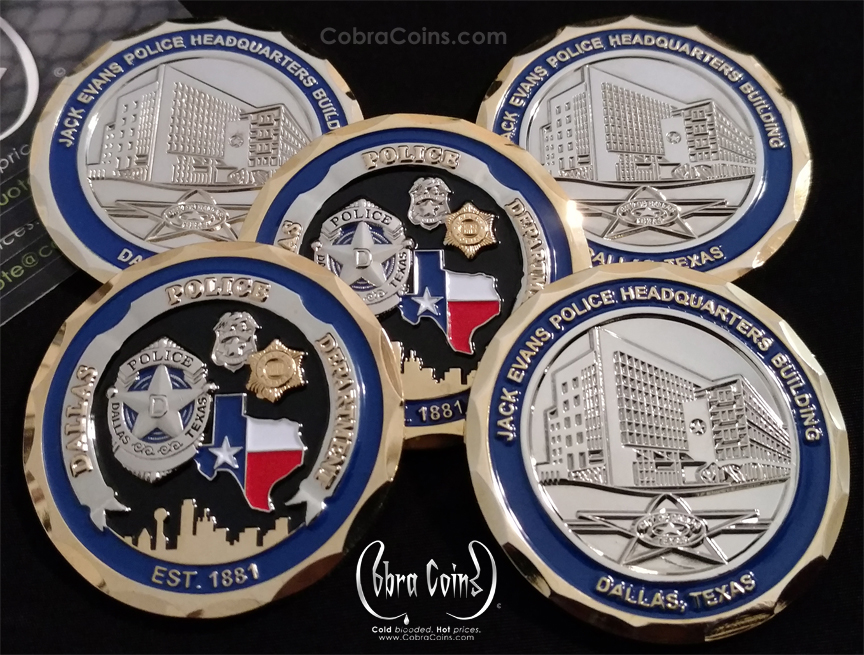
Above, the Dallas Police Department coin has black, red, white, and 2 shades of blue. If you want enamel colors on your coin, Pantone colors may be provided to you. A Pantone color is a specific number referring to a specific shade of color. Pantone colors can be a combination of numbers and letters (photo below).
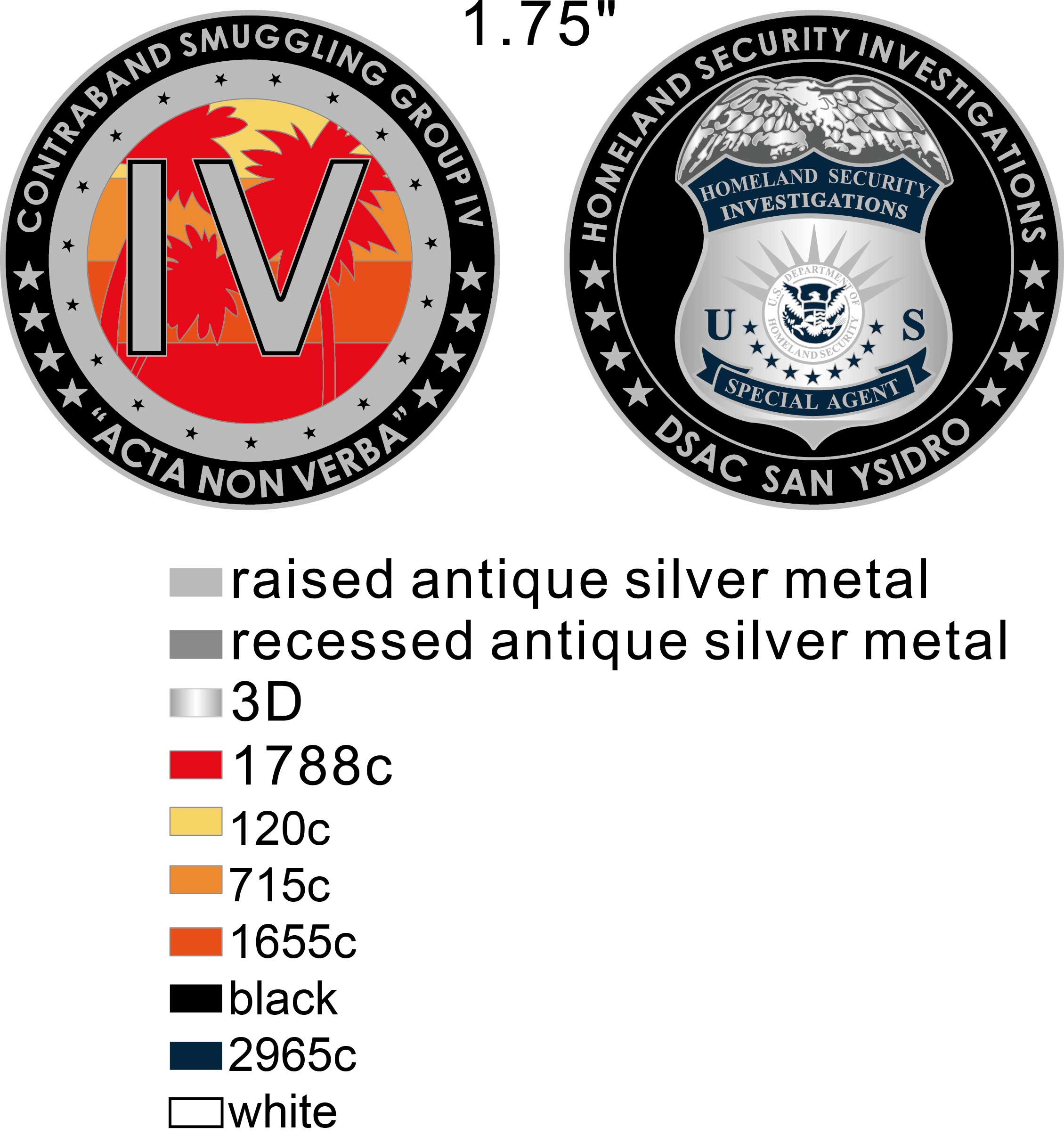
In the image above, 4 different shades were used to achieve the sunset in the sky. Because the color orange has hundreds of different shades, those Pantone color numbers above (715c, and 1655c) refer to the exact shade of orange to be used. Enamel colors can’t be used to create gradients because the colors will just run together. A gradient is a fade or transition from one color to another.
Please note: Some companies have trademarked their color. This prevents others from using their shade of: brown (UPS), red (Coca-Cola), and even green (Starbucks). There is a LOT more info about this, but keep in mind you might be prevented from using a specific color shade because it’s been trademarked.

Above is the finished Homeland Security Investigations coin (Department of Homeland Security / DHS). The shades of yellow and orange were added to the coin. You can add as many enamel colors on your coin as you wish. You’re limited by the coin’s space and your budget.

Not all enamel colors are created the same! We also offer semi-transparent enamel. In the 616 ACOMS Fire Birds challenge coin above, the red and blue enamel colors are semi-transparent which allows you to see the flames under those colors (right above the word: BIRDS).
Please note: Enamel colors are suggested to make your coin REALLY pop, but they’re especially suggested if you have a shiny coin. This will allow you to read the text better because shiny coins can be hard to read. What’s a shiny coin? Let’s find out!
Coin Metal and Finishes
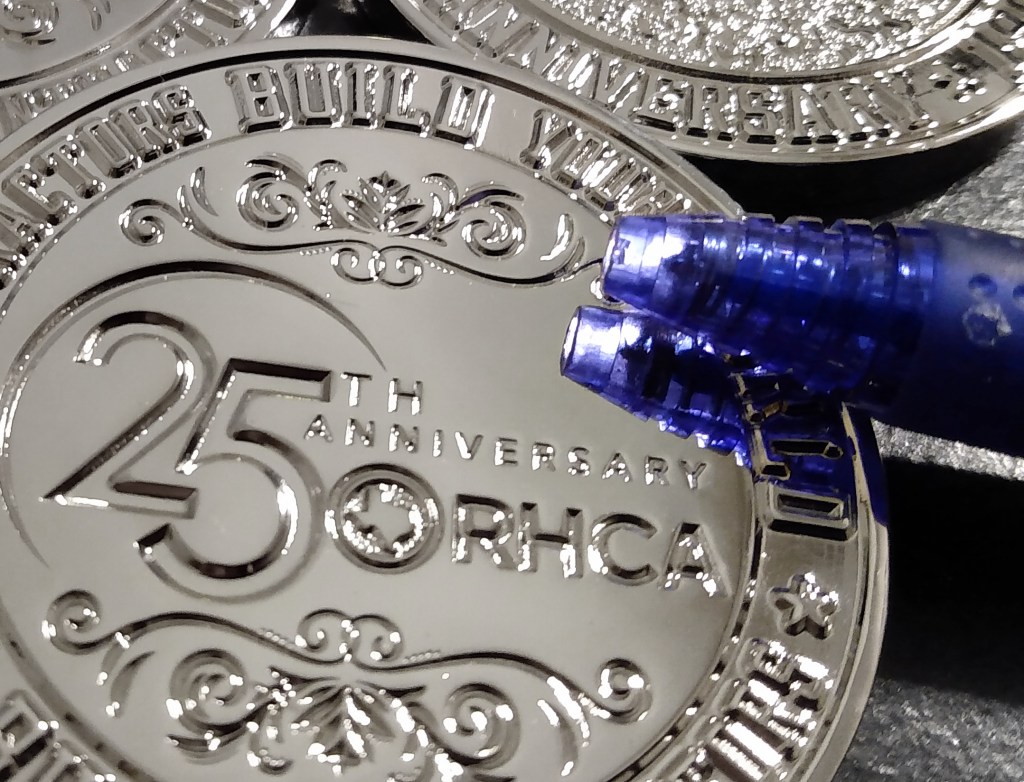
Have you ever seen a super shiny, new quarter? It can be hard to read the details because the coin is SO shiny. Now think of an older, faded quarter. The text is easier to read because it’s not as reflective. A shiny coin is super shiny and highly reflective. An antique coin is not reflective and isn’t shiny.
In the RHCA coin below, the Shiny Silver coin is so shiny it’s acts like a mirror reflecting the blue pen.
Whichever coin finish you choose: Shiny or Antique, we make sure your design is exactly what you want!
Choosing a metal for your coin might seem difficult, but it doesn’t have to be. We offer 9 different metal finishes: Shiny Gold, Antique Gold, Shiny Silver, Antique Silver, Shiny Brass, Antique Brass, Shiny Black Nickel, Shiny Copper, and Dual Plated Shiny Gold & Shiny Silver.
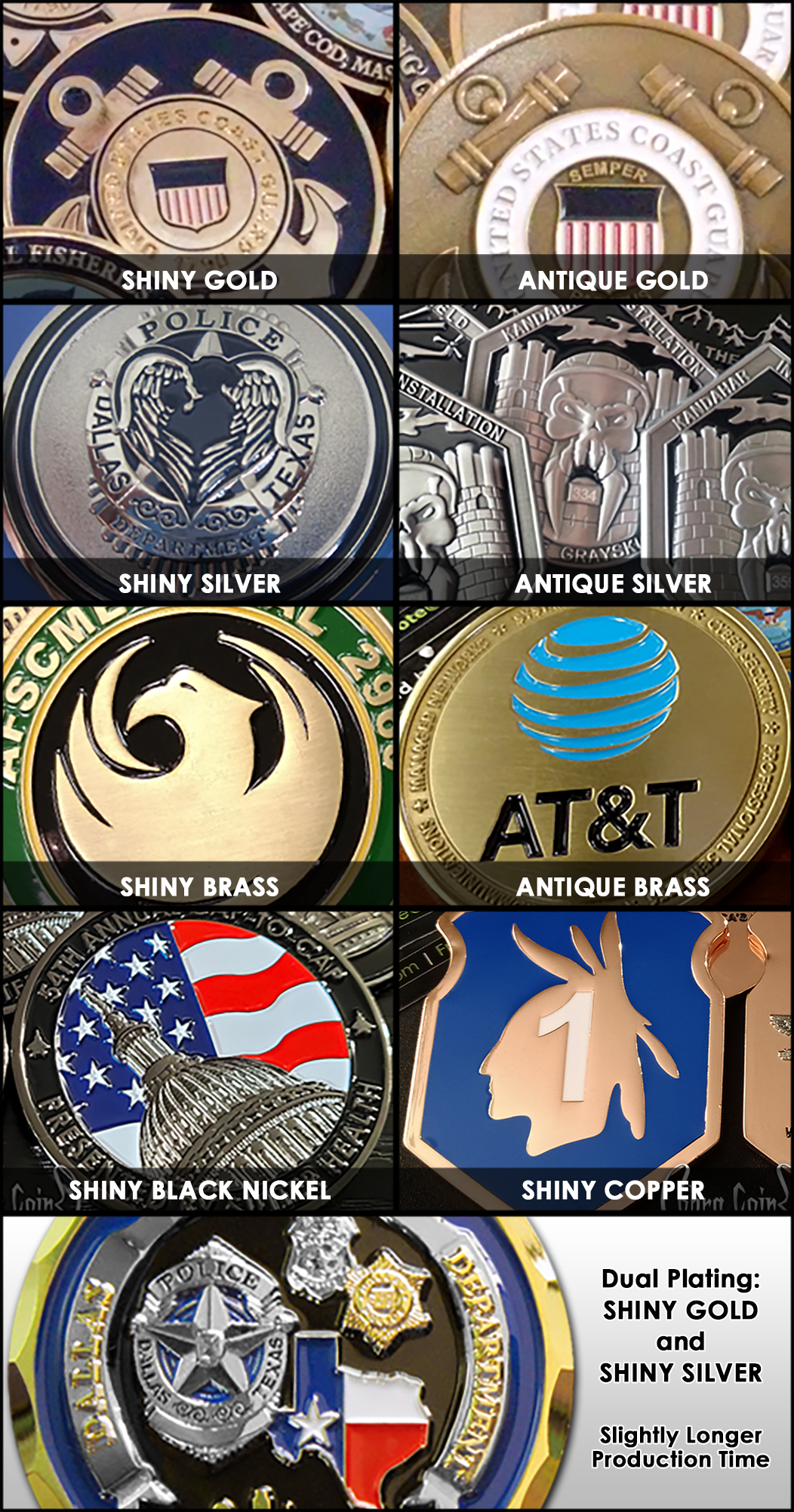
The industry standard metal finish is Antique Silver. The 4 easiest metals to recognize (and the most common) are Shiny Gold, Shiny Silver, Antique Silver and the dual plated one (pictured below).
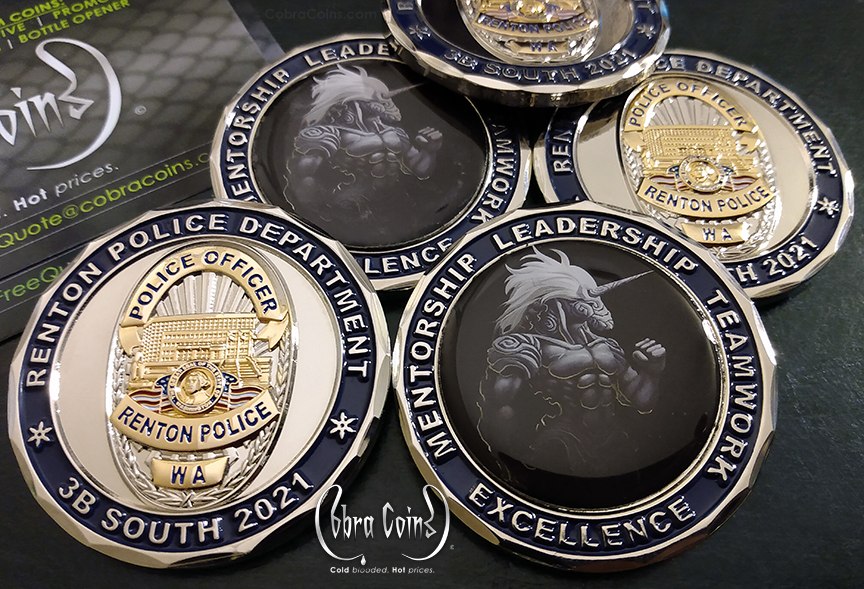
The Renton Police Department coin above has the Renton Police Department badge. It has areas which are Shiny Gold and other areas which are Shiny Silver. The image of the unicorn on the Back is Offset Printed, but more on that later.
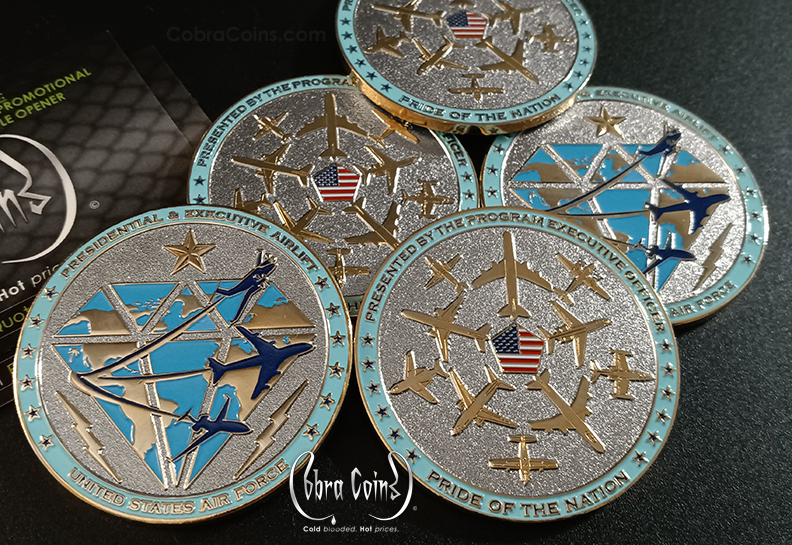
The Presidential & Executive Airlift coin above has both Shiny Gold and Shiny Silver on BOTH sides of the coin! The majority of the coin is Shiny Gold which includes the continents, lightning bolts, and planes. The Shiny Silver areas are the backgrounds of the coin.
Coin sizes
Challenge coins can vary in size from 1.25 inches all the way to 4 inches wide. These can even include challenge coin sizes in between (photo below).

The SRT challenge coin above is 4 inches wide and about 1 1/8 inches tall.

The 1 Peter Bible Verse photo above is a coin which is 1.25 inches tall. This coin is meant to be worn around the neck using the hole above the cross. Currently, the industry standard size for a round challenge coin is 1.75 inches.
Round and Non-round coins
Round coins are exactly that: coins which are round. This is the standard coin shape – as shown in this Northeast Regional Fisheries Training Center coin.
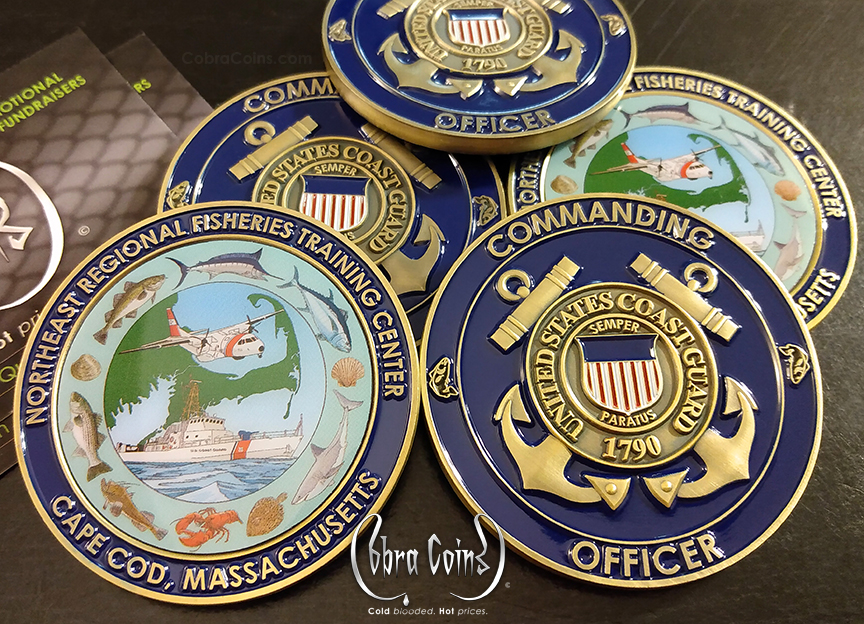
Non-round coins are challenge coins which have ANY shape other than round. 3 examples are included below.

This 1-1 Rigger coin is non-round. It’s shaped like a parachute with wings and is Antique Silver.
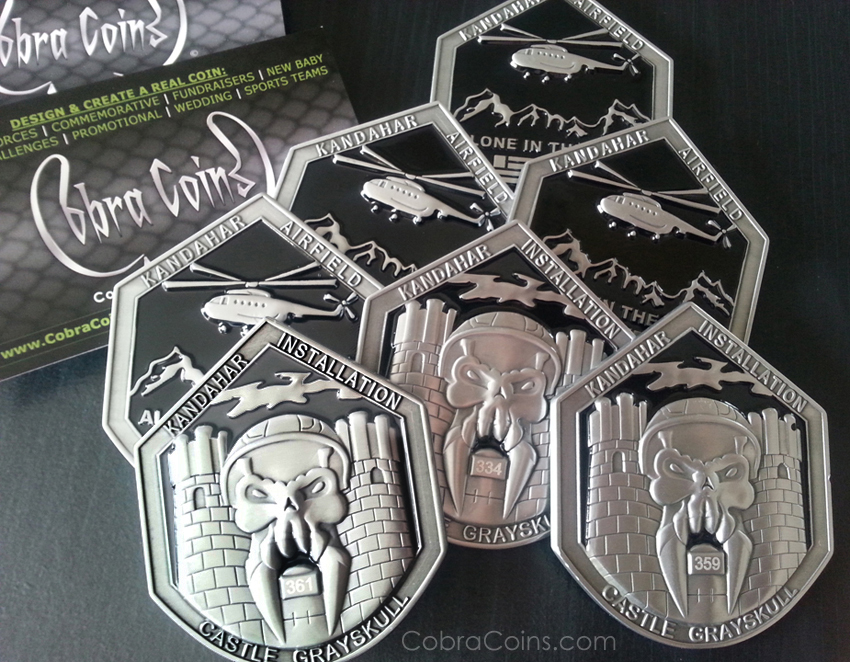
The Kandahar Installation / Castle Grayskull coins above are Antique Silver, and are crest shaped. They include images representing the Kandahar Airfield.

Non-round coins can have almost any shape! The 52D Communications coin above is created in the shape of Germany. It celebrates the US and Germany’s cooperation in the Spangdahlem Air Base.
Offset Printed coins
Offset printed coins are optional designs which can include your photo, logo, design and even a character! Offset Printing can be used when the design is too complicated for enamel colors, too small, and/or when the design has gradients. Below are some Offset Printed coin examples.
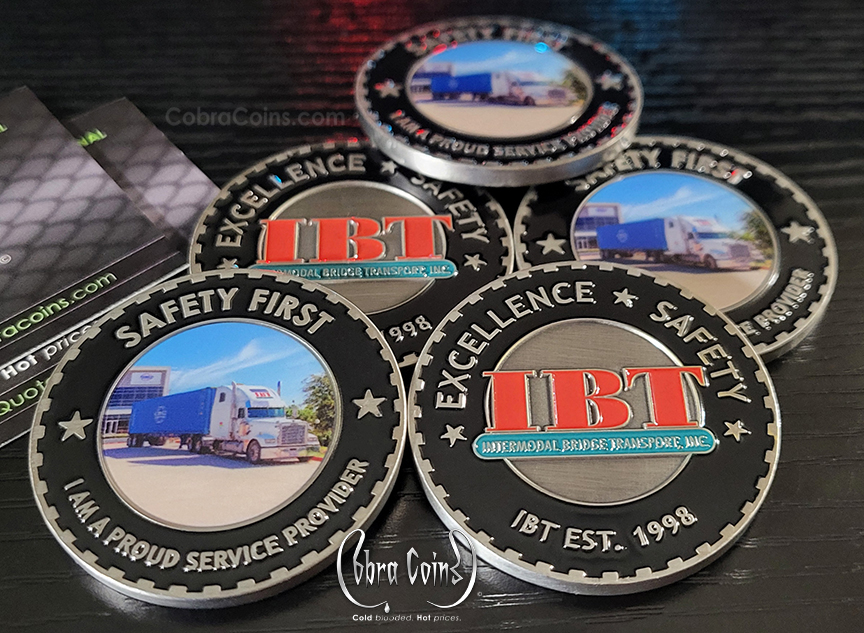
In the Intermodal Bridge Transport coin above: the 18 wheeler, the sky, pavement, building and trees are all considered an Offset Printed area.

The Amphibious Squadron Eleven coin above uses a smaller, Offset Printed area for the green gator on the Back. Their logo is too small and too complex for enamel colors.
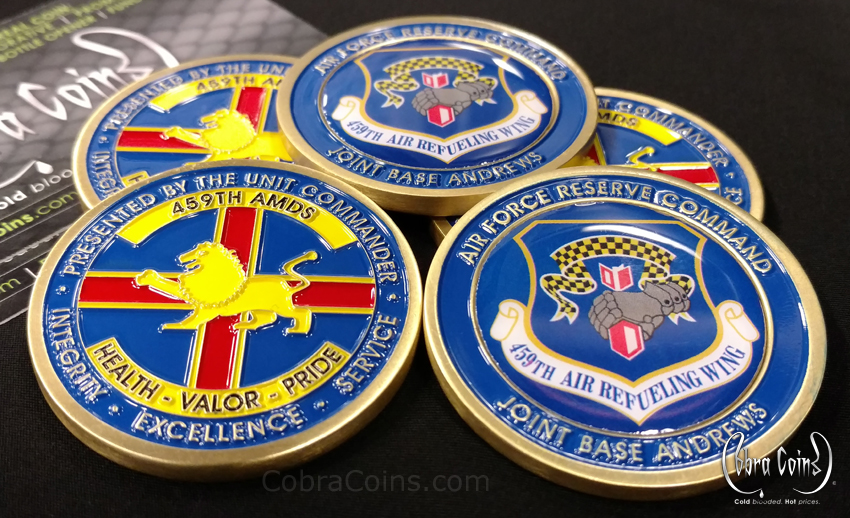
The shield of this 459th AMDS coin is the Offset Printed area. The background shade of blue was matched to the shade of blue enamel surrounding the text: Joint Base Andrews.
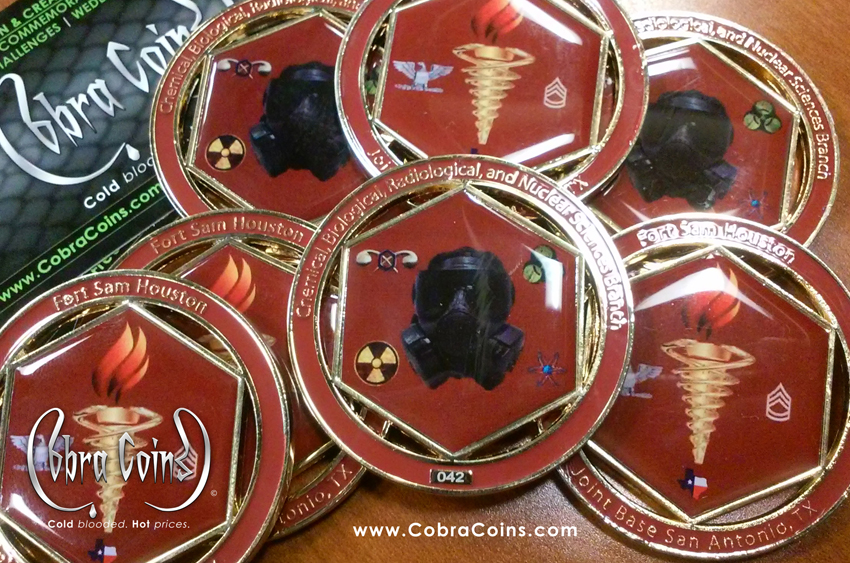
Not all Offset Printed areas need to be round! This Fort Sam Houston coin uses hexagonal shaped Offset Printed areas on the Front and Back.
Please note: all Offset Printed areas must have epoxy. This will prevent the Offset Area from flaking, peeling, and minor scratches. More about epoxy right now…
Coins with Epoxy
Epoxy is an optional addition to your coin – unless you have an Offset Printed area. Epoxy is a clear, protective coat added to your coin. Epoxy can be added to all, or some parts of your coin. It’s used to protect your coin from minor dings and scratches. Below are just a few examples of coins with epoxy.
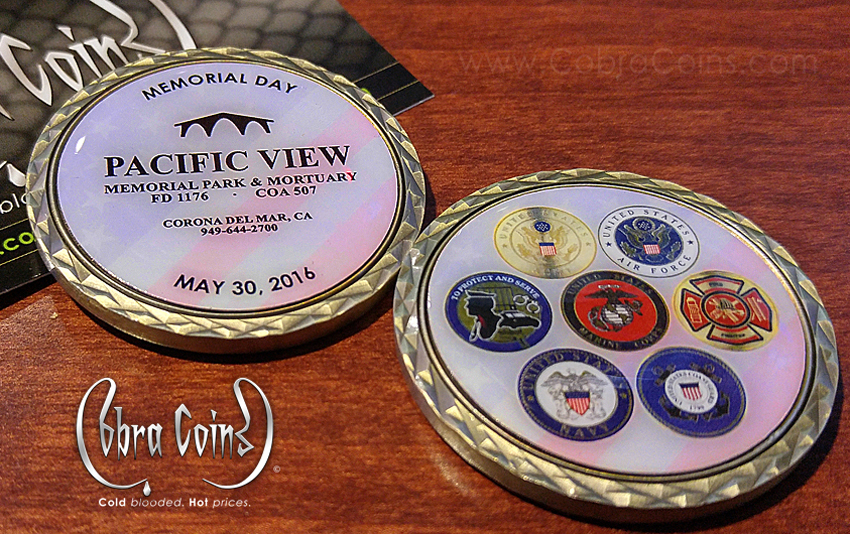
This Pacific View Memorial coin has BOTH the Front and Back covered in epoxy. The customer wanted their design to be protected. You can see a tiny light reflecting to the left of the word: PACIFIC. This indicates there’s epoxy.

The Naval Criminal Investigative Service coin above has epoxy added to the 2 round seals on the Front of the coin. You can see a light reflecting off the epoxy over the word: MARINE and the second light is covering the words: STATES OF
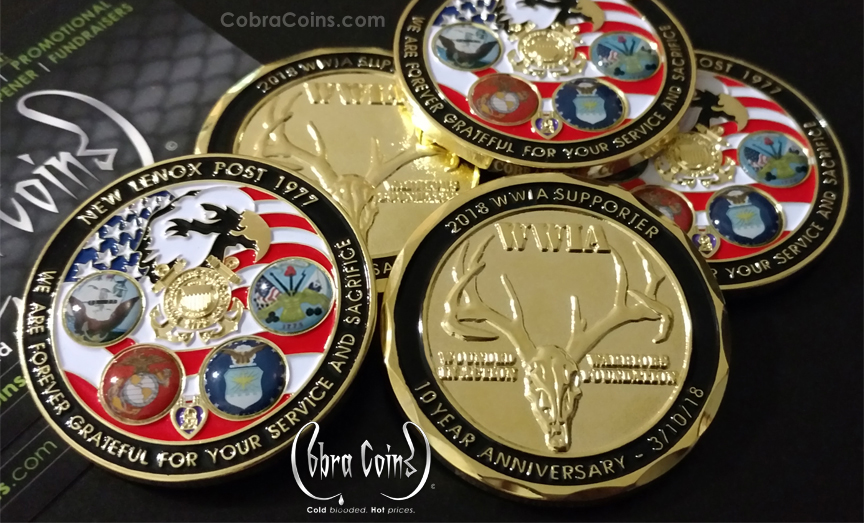
In this New Lenox Post 1977 coin, 4 different areas of the coin have epoxy. Using what you’ve learned, can you spot them? Answer: the epoxy is over the 4 seals on the US flag side of the coin.
2D vs. 3D coins
This is where challenge coin designing becomes REAL! Coins which have 3D elements are arguably the best designed coins.
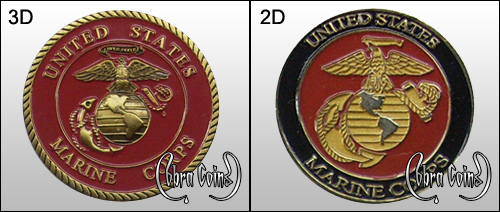
Technically, all coins are 3D. However, in the challenge coin industry, a 3D coin refers to the areas which “pop” out like the USMC globe in the image above on the left. The logo has curves. The text on that same coin are considered 2D (even though they “pop” out and you can feel them with your thumb, too). The coin on the right is using the same logo, but isn’t considered 3D because it doesn’t “pop” out like the logo on the left. The logo on the right is the same height as the text and is considered a 2D coin. Let’s look at another example below.

The Front (left) side of the WCCW Emergency Response coin above has a 3D team, 3D bridge, and 3D water. All those elements have curves and the designs “pop” out. The text around the Front is considered 2D. Looking at the Back of the coin (the image on the right): the eagle, US flag, arrows, and shield are considered 3D because they all “pop” out. The text on this side is 2D. Let’s look at a 3rd example, this time from Lockheed Martin:

Looking at the Lockheed Martin challenge coin above, only one side has 3D elements. Which side do you think is 3D? Answer: the aircraft carrier, submarines, and waves are all 3D. They all have curves and they “pop” out. The text on both sides of the coin, and the Lockheed Martin logo on the back are all considered 2D because they are the same height. Let’s look at one last example.

Looking at the Redlee / SCS Inc. coin above, only one side has 3D elements. Can you tell which side? Answer: the eagle on the Front is a 3D design because the design “pops” out. The text on the red side of the coin is 2D. All the design elements on the blue side of the coin are 2D because they don’t “pop” out, they’re just raised.
Sequentially Numbered coins
Sequentially numbered coins have an optional area to add numbers. Those numbers are laser engraved in the selected area. Sequential numbers can be added to Shiny or Antique coins.

For the 3/1 SFAB Excellence coin above, the laser engraved area was chosen to be on the Shiny Silver side of the challenge coin.
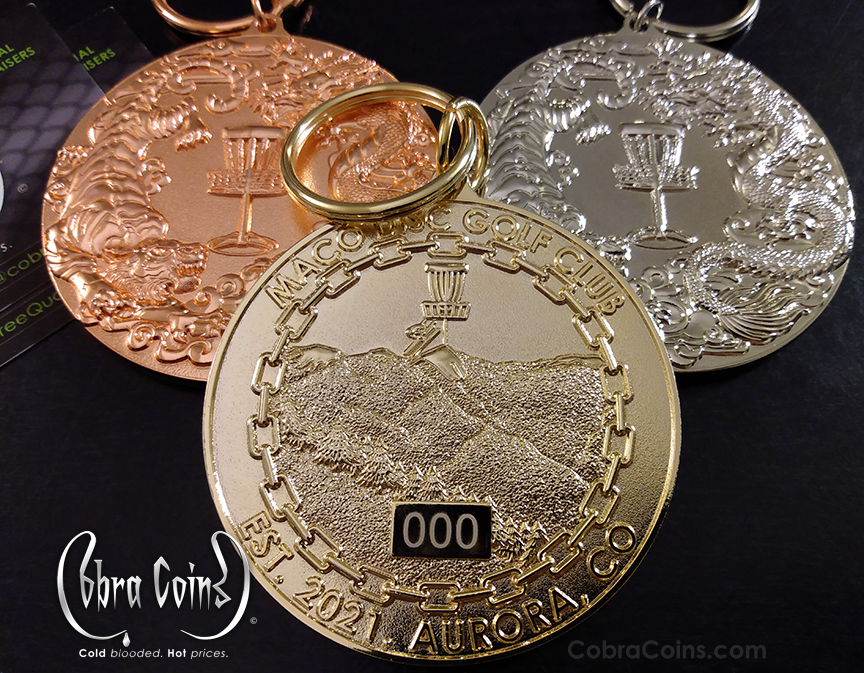
The Maco Disc Golf Club above coins are created in Shiny Gold, Shiny Silver, and Shiny Copper. The sequentially numbered area was chosen for the Front side of each of these large, keychain challenge coins.
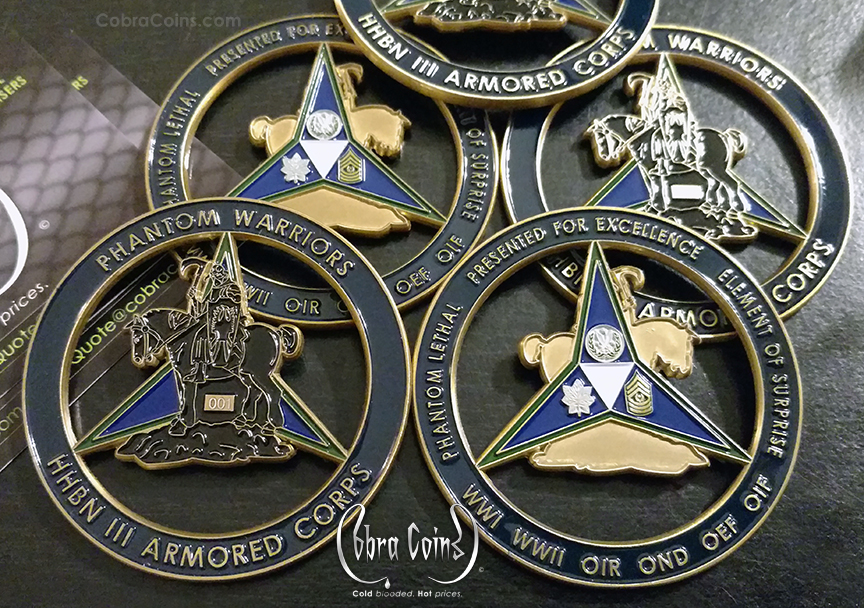
This Phantom Warriors coin has the sequentially numbered area slightly smaller to fit in the area under the horse and Phantom Warrior.
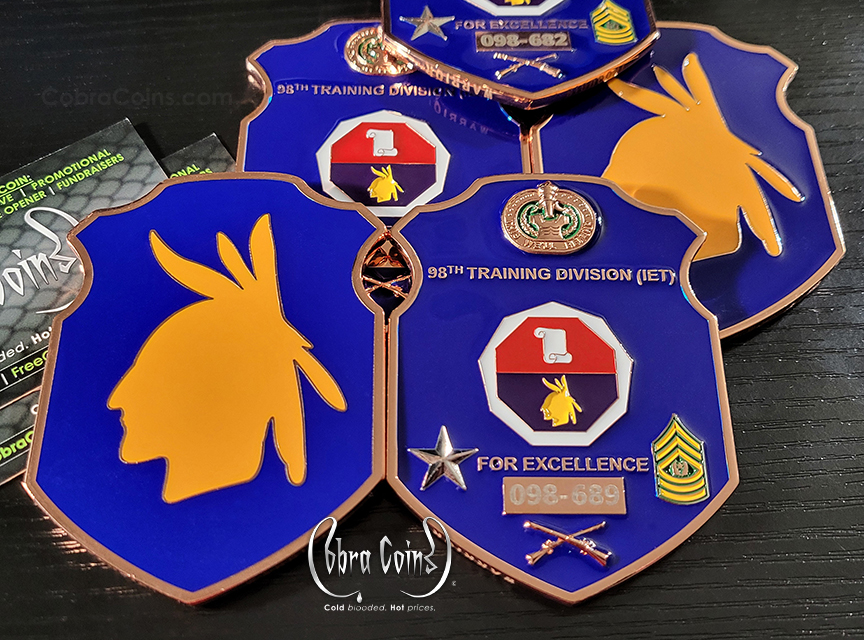
Special characters can be added to the sequentially numbered area! In the Iroquois Warrior coin above, a dash (-) has been added. We can also include letters such as: B21 – 001, B21 – 002, B21 – 003 and so on.
Edge Cuts
We offer 4 different edge cuts. Edge cuts are optional designs added to the outside edge of your coin. You can choose from Diamond, Swirl, Wave, and Petal edge cuts.
Your coin can have an edge cut on one side, and a different edge cut on the other side! You can also choose to have an edge cut, and the normal rim on your coin on the other side.
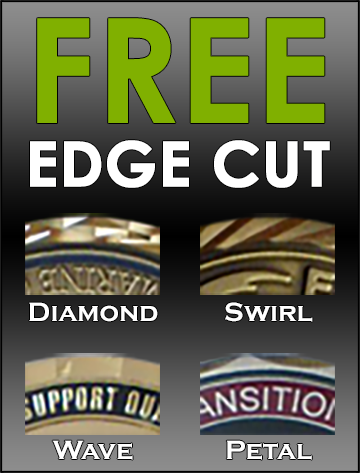
Let’s look at examples of each edge cut below.

The Teichert Veteran Appreciation coin above has Diamond Edge cuts on both sides.

The Air Force Test Center coin above has Swirl edge cuts on both sides.
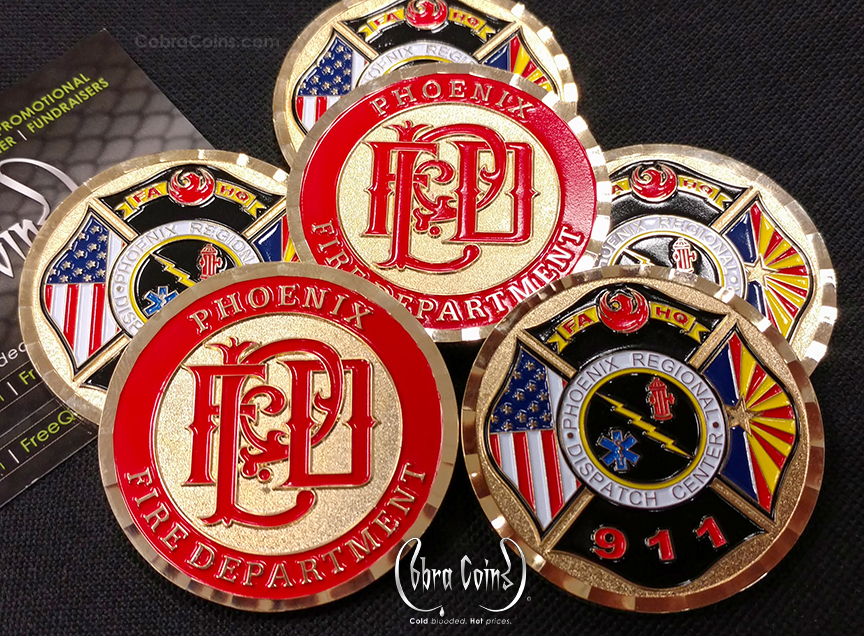
The Phoenix Fire Department coin above has a Wave edge cut on both sides.
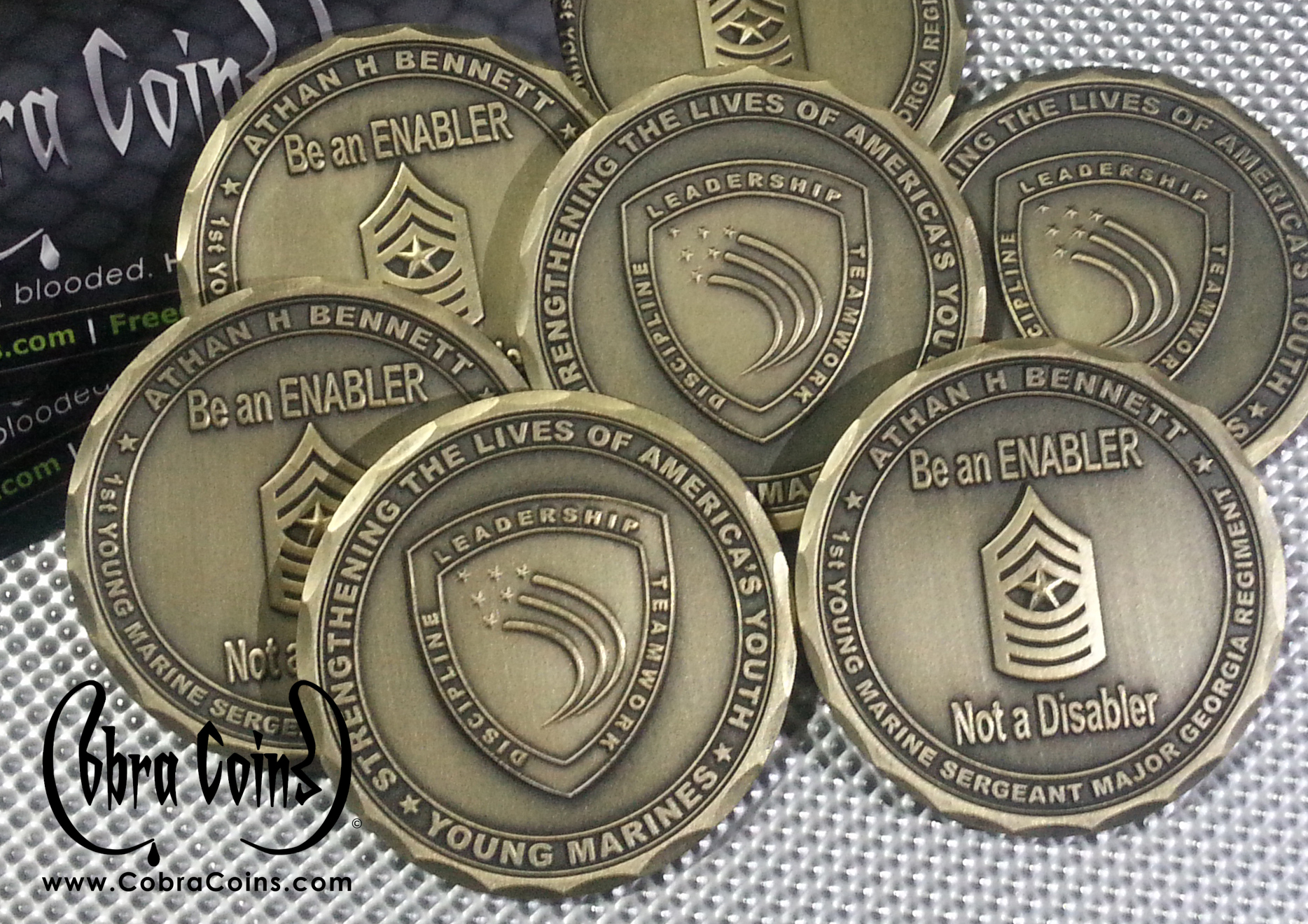
The Young Marines coin above has Petal edge cuts on both sides.
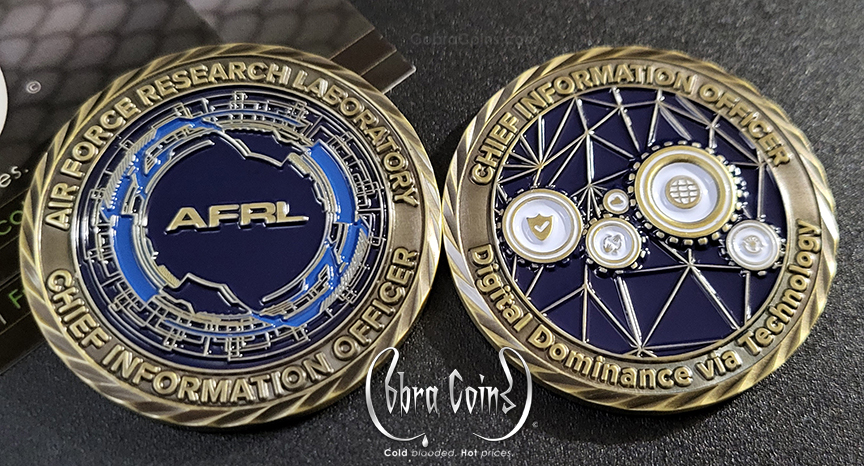
This is the Air Force Research Laboratory coin. Can you guess the name of the edge cut used in the coin above?
Please note: All of these edge cuts can only be used on round coins. Answer: the AFRL coin has a Swirl Edge cut on both sides.
Reed Edge
A reed edge is an optional, raised, and ribbed rim added to the outside of your coin (photo below).
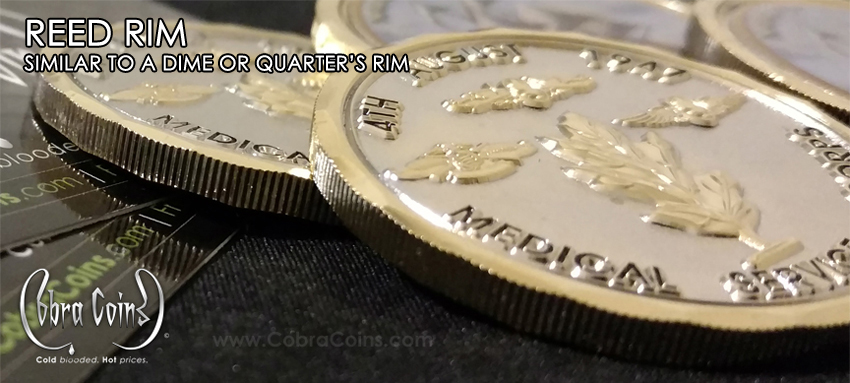
The reed edge on this Medical Service Corps coin (above) is similar to a quarter and dime’s rim. If you choose not to have a reed edge, your coin’s rim will be smooth, similar to a nickel and penny’s rim (photo below).
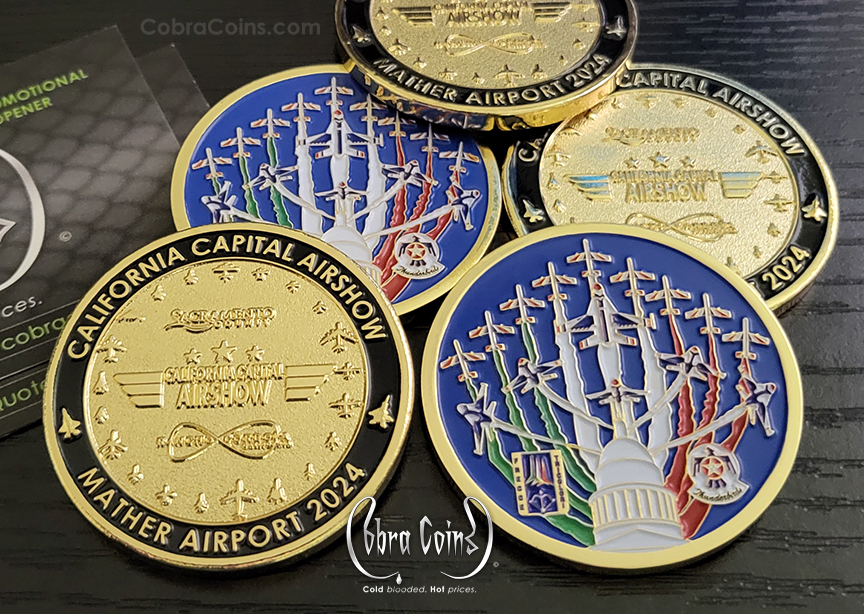
In the California Capital Airshow coin, you can see the smooth outer edge…just under the words: Mather Airport 2024 (look at the coin on top).
Please note: you cannot have a coin with reeded edge and an edge text. More about edge text right now…
Edge Text
Laser engraved edge text is text written along the outside edge of a coin (photo below).

Nearly any text can be added to the outside rim of your challenge coins. This text will be laser engraved near the end of the coin production process. Text and very small images can be added around the coin to further customize your coin!
Please note: Many challenge coin companies add THEIR company name to YOUR coin without telling you. We ONLY add our name if you want it there.
Please note again: you cannot have a coin with reeded edge and an edge text.
Sandblast Texture
Sandblast texture is a type of texture usually added to the background of your challenge coin. This is a great way to add depth, character, and texture to your coin.
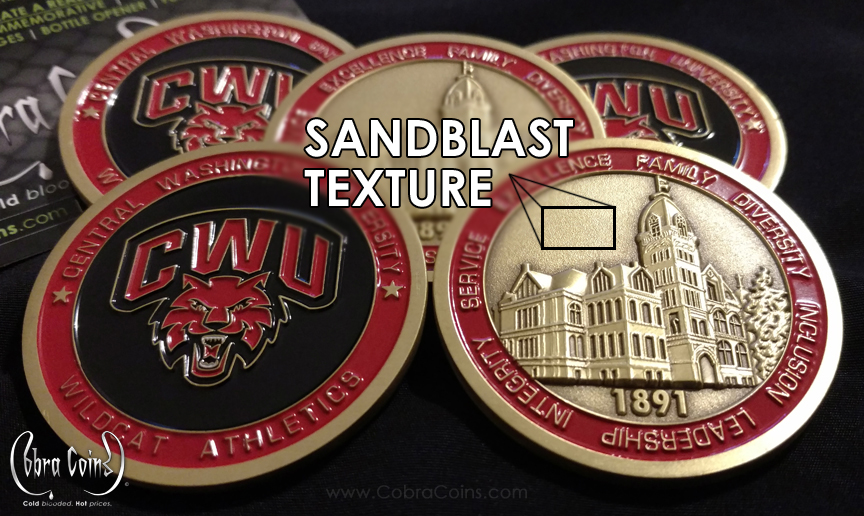
The sandblast texture is added to the background of this Central Washington University coin.

The Front side of this North Central Patrol coin created for the Dallas Police Department has a sandblast texture.
Please note: Sandblast texture can be added to both Antique and Shiny coins – even if they’re non-round!
Coins with cutouts
Cutouts, which are also known as cut outs, are coins with an area inside them removed. This design feature is entirely optional.

The 1st Battalion, 26th Infantry Regiment challenge coin above is known as a bottle opener coin. An area of the coin was removed and a flat bevel edge was kept. This bevel is used to remove the bottle cap from the bottle. These bottle opener coins must be created slightly larger than a normal sized coin to accommodate the mouth of the bottle.

The Love’s Connect Mobile Team coin above is a cutout coin. The cutout area is in the shape of their logo.

Cutout coins can have nearly any shape as shown in the coin above. This Operation Inherent Resolve challenge coin has the area around the gauntlet (or glove) removed. This design beautifully emphasizes the design of the coin.
Getting a coin Proof
Most challenge coin companies (including Cobra Coins) will provide you with a digital Proof of your coin.
Proofs will show your coin’s layout, both the Front and the Back. It will list the enamel colors to include on the coin, and will give you a better idea of how your finished coins will appear.
In the Proof below, the Dallas Police Motors Department wanted a coin celebrating their involvement in the FIFA World Cup.
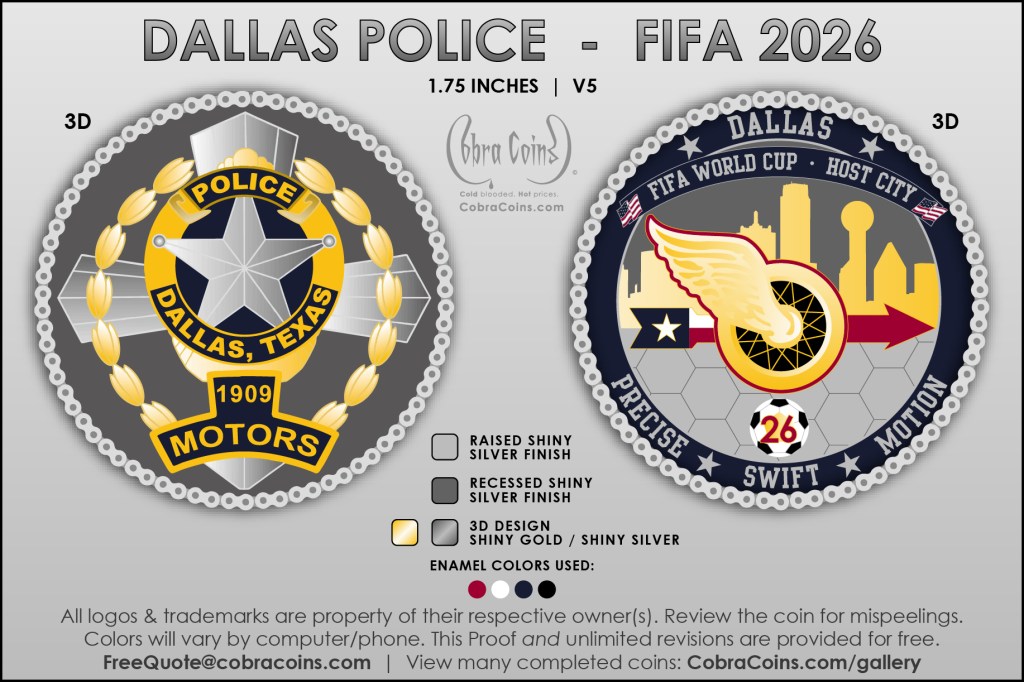
Some companies charge to give you a Proof. At Cobra Coins, we offer this digital Proof for free and we include unlimited revisions – we want you to love your final design! Don’t be limited to 3 revisions like some challenge coin companies offer.
Once you make your edits and make the payment: you’ll receive your coin after it’s produced and shipped. Below is the actual coin we produced using the Proof above.
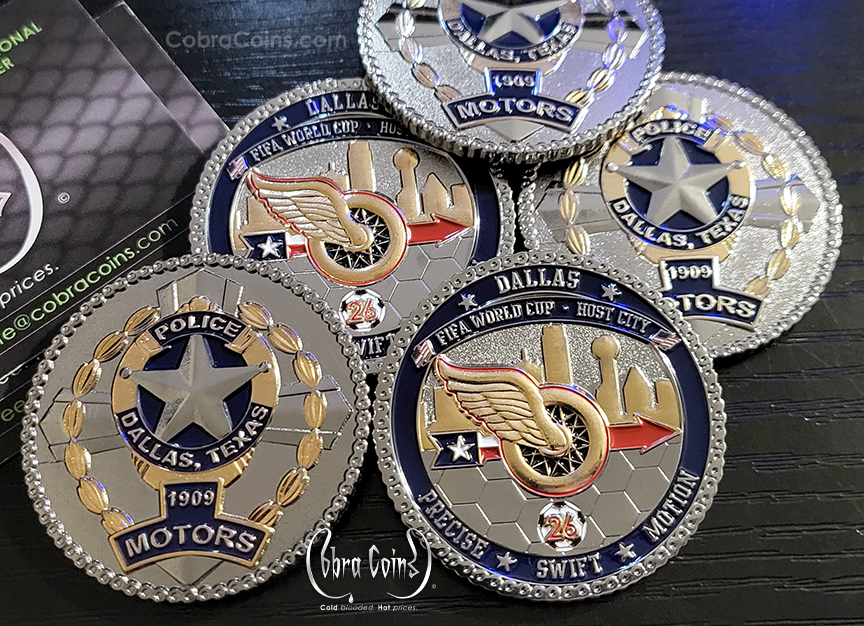
Above is the completed Dallas Police Department FIFA World Cup coin. You can see the Shiny Gold and Shiny Silver areas were created as requested. Even the smaller US flags have their enamel colors!
What are dies / molds?
What is a die and what is a mold? Many challenge coin companies use both words to mean the same thing, but they’re technically two different things. Dies (pictured below) are super heavy, cylindrical objects, and are made from solid steel. They have your coin’s Front or Back design, but backwards! Your coins are usually made from brass metal, so we use steel dies like these to mint your coin onto the “softer” brass metal.
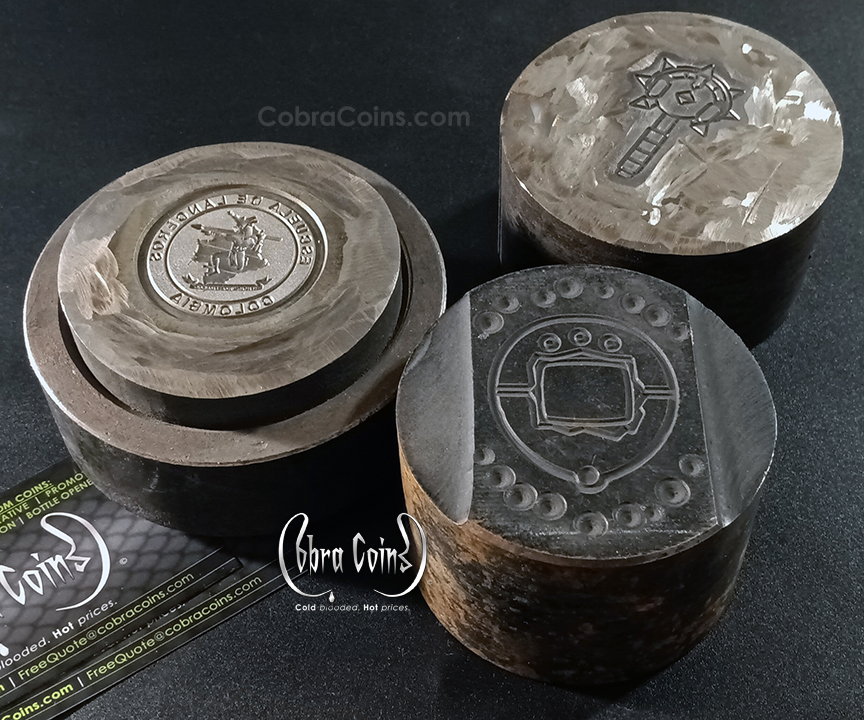
Both sides of your coin are minted using hydraulic presses and TONS of pressure. This is the same way US coins are minted.
Molds are a cost effective way to create challenge coins. Those coins are made from something other than brass metal. Coins made from molds are usually made from a metal alloy (alloy means mixture) of brass and zinc. This metal is even “softer” than solid brass coins. This metal alloy is heated super hot and poured into your coin molds. Once the metal alloy is cooled, it’s removed from the molds and goes to the next step in the production process.
Coin Thickness
The industry standard thickness for a challenge coin is 3mm.

It’s a little difficult to tell, but the coins above are thicker than the standard size. These Amphibious Squadron Eleven coins are 4mm thick.
Please note: Some challenge coin companies offer the thicker 4mm coins, but they’re usually made from a lighter, metal alloy of zinc and brass.
Coin Packaging Options
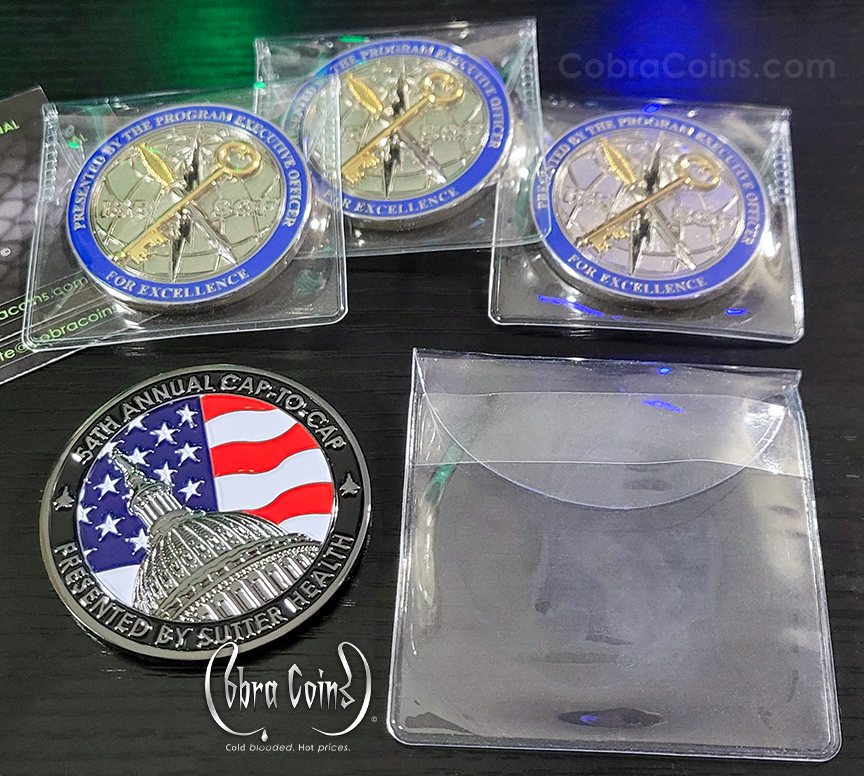
Once you receive your order from Cobra Coins, they’ll arrive in the individual, vinyl sleeves pictured below. This is the standard packaging and is included at no additional charge as shown in these Program Executive Officer coins and in the 54th Annual Cap to Cap coin.
The Dallas Police challenge coins pictured below are in an optional case. These clear, plastic cases provide a better presentation for an already awesome coin!
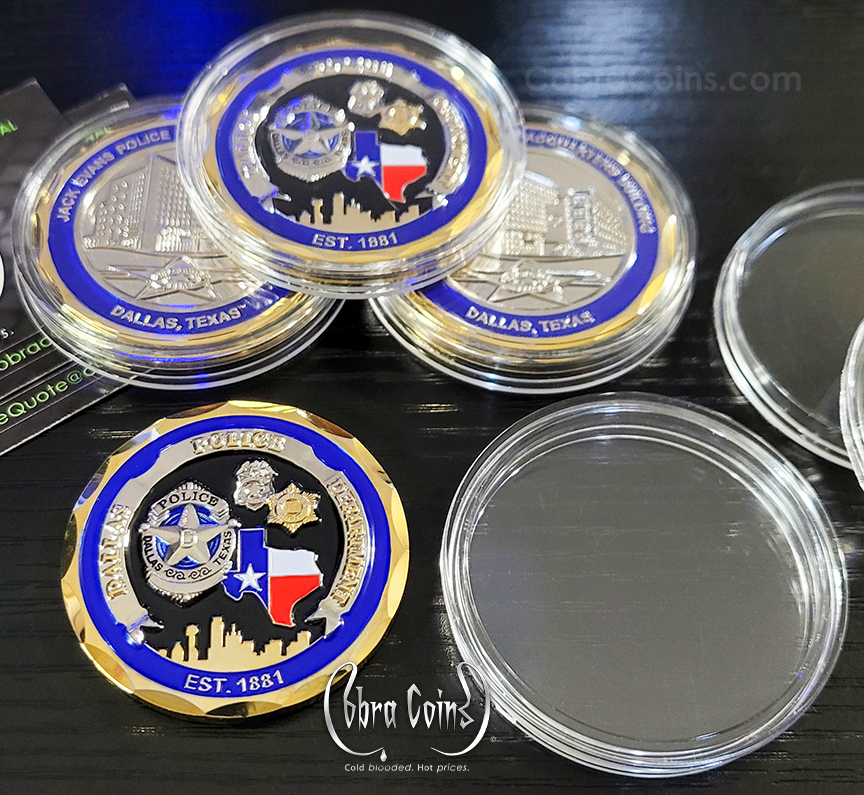
Whichever presentation option you decide, your coin will receive our professional attention and exceptional quality assurance.
How many coins should I order?
You can order as many coins as you wish. If you plan to sell, present, or gift your coins you can always reorder more! We’ve created single, 1 production coins and we’ve had orders nearing 10,000 coins for a single coin design!

The above Independent Duty Corpsman coin (IDC), was created for Class 16020. It has semi-transparent blue and red enamel, cutouts, and is 3D on both sides.
Test Yourself!
Below are 3 photos – let’s see what you’ve learned! Just by looking at the coin photo below, what can you tell about the coin? The answers are below each photo…
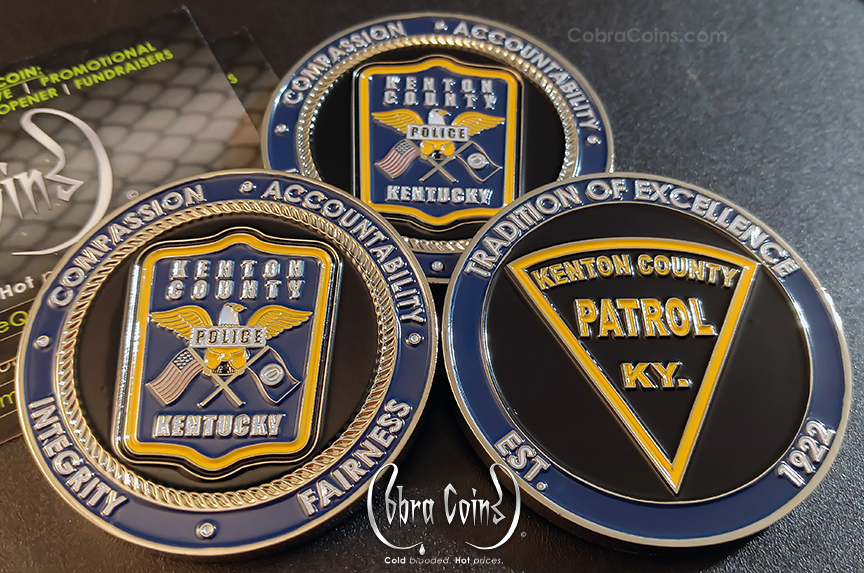
Just from looking at the Kenton County, Kentucky coin above we can tell several things. This is a round coin with a Shiny Silver finish, it has enamel colors (5 colors), has a 2D Front and a 2D Back. It’s impossible to tell from the photo, but it’s 2 inches and is made from heavy, solid brass metal. How did you do? Here’s another coin:

Right away we can tell this Training Aircraft Division coin is a non-round coin. It also has enamel colors (3 colors), a 3D Front and a 3D Back, and has an Antique Brass finish. If you guessed Antique Gold, you’re still doing great! Antique Brass and Antique Gold are very close in shading and still trick the best experts. Here’s one more coin:

This Super Hercules, non-round coin has enamel colors only on one side (6 colors), it’s a bottle opener coin (it also has a cutout), is Antique Silver, it has a 3D Front and 3D Back (the aircraft and crests “pop” out), and it has laser engraved sequential numbering. Ok, one more BONUS coin! What can you tell about the coin below?

The 321st Expeditionary Military Intelligence Battalion coin is round, has enamel colors on both sides (5 colors), is Shiny Gold and Shiny Silver (the leaf rank on the Front left is Shiny Silver), it has an Offset Printed Panther, a Diamond Edge cut on both sides, AND has a 3D Front and 2D Back. This massive coin is 3 inches and is made from solid brass metal. How did you do?
Congratulations!
You’ve just completed learning the challenge coin basics! You can now recognize 4 different edge cuts, cutouts, 3D designs, and even Offset Printed areas!
We are very proud of you! Please use your knowledge for good and fill out our coin form about that coin you’ve been wanting! You can also email us: FreeQuote@cobracoins.com
Want even more coins to test your skills? Visit our Challenge Coin Gallery.

 Cobra Coins